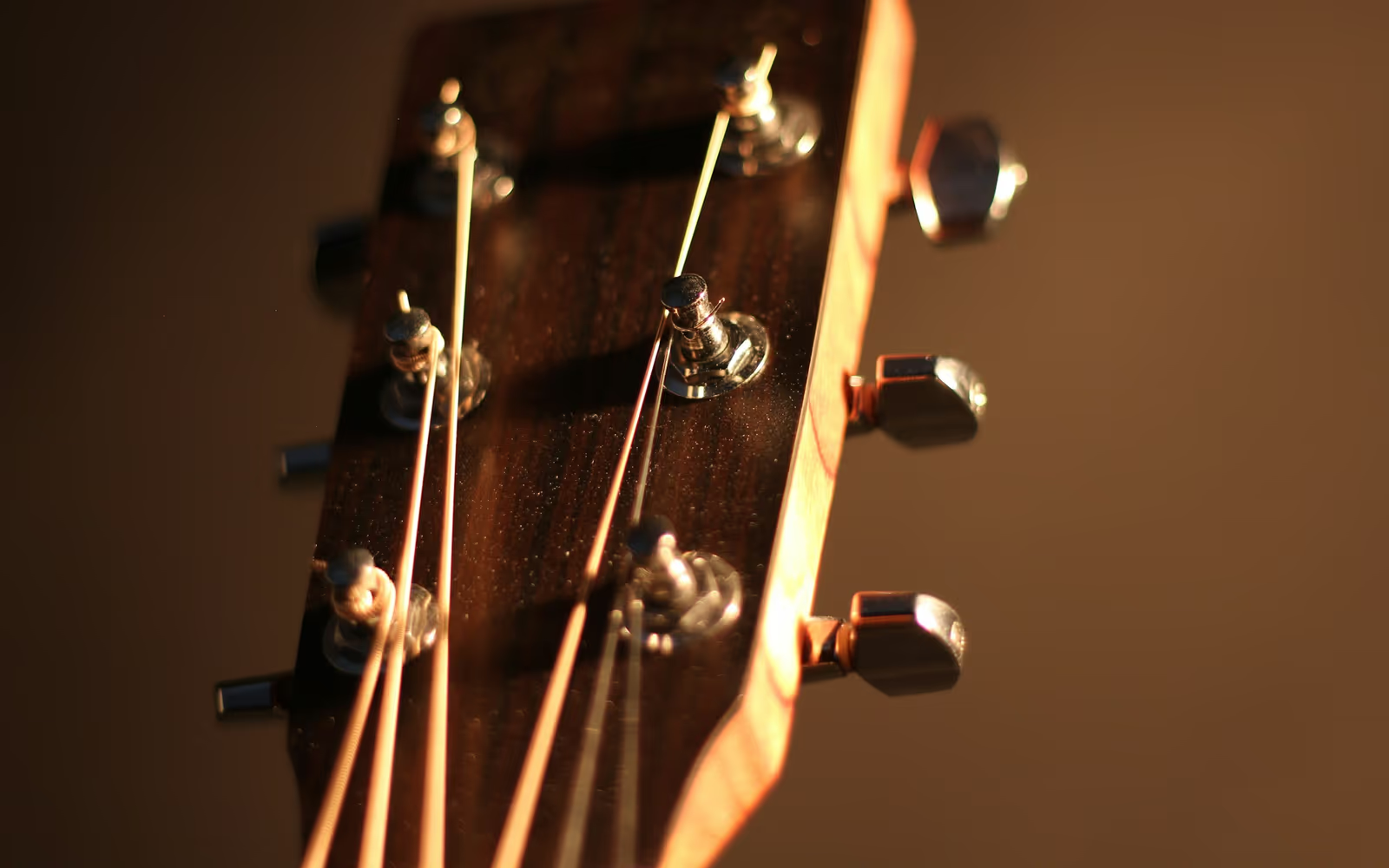

Standard guitar tuning, from the thickest string to the thinnest, is E A D G B E. With A4 set to 440 Hz the six target pitches are E2 at 82.41 Hz, A2 at 110.00 Hz, D3 at 146.83 Hz, G3 at 196.00 Hz, B3 at 246.94 Hz and E4 at 329.63 Hz. The tuner shows these numbers on the string buttons, so you can see what each string is aiming for.
Start with the sixth string, the low E. Pluck it, let it ring, and watch the needle. If the arrow points up, tighten the string a little; if it points down, loosen it. Small turns work better than big ones, because a string keeps moving for a moment after you let go of the peg. When the needle sits in the middle and the note turns green, move on to the fifth string and repeat.
Once all six strings are done, check them again from low to high. Tuning one string changes the tension on the neck slightly, which can pull the others a few cents out, especially on guitars with a floating bridge or brand-new strings. A second pass usually takes a few seconds and leaves every string with a tick.
If a string is far out, for example after a string change, the tuner may decide it is closer to the next string. Tap the string you are tuning to pin it. The needle then measures only against that note and tells you how many semitones away you are, so you can bring it up without guessing.
Alternate guitar tunings
Pick a tuning from the Tuning menu and the string buttons change to match. These are the tunings built into the tuner, listed from the sixth string to the first.
Drop D: D2 A2 D3 G3 B3 E4. Only the low E drops a whole step, to 73.42 Hz. A single finger now plays a full power chord across the bottom three strings, which is why rock and metal players use it.
DADGAD: D2 A2 D3 G3 A3 D4. The sixth, second and first strings drop a whole step. The open strings form a suspended chord that suits Celtic and folk fingerstyle playing.
Open G: D2 G2 D3 G3 B3 D4. The sixth and first strings drop to D and the fifth drops to G at 98.00 Hz, so the open strings play a G major chord. Slide players love it, and a single finger across a fret makes a major chord.
Half-step down: E♭2 A♭2 D♭3 G♭3 B♭3 E♭4. Every string drops one semitone, so the low string sits at 77.78 Hz. Guitarists use it to match recordings tuned this way and to give singers a slightly lower key without new chord shapes.
Lower tunings put less tension on the strings, so they can buzz or feel loose. If you live in an alternate tuning, a slightly heavier string set may feel better.
Bass, ukulele, violin and cello tunings
Four-string bass is tuned E1 A1 D2 G2: 41.20 Hz, 55.00 Hz, 73.42 Hz and 98.00 Hz. That is the same note names as the bottom four guitar strings, one octave lower. A five-string bass adds a low B0 at 30.87 Hz below the E. Those are very low frequencies for small microphones, which is why the tips above suggest tuning harmonics.
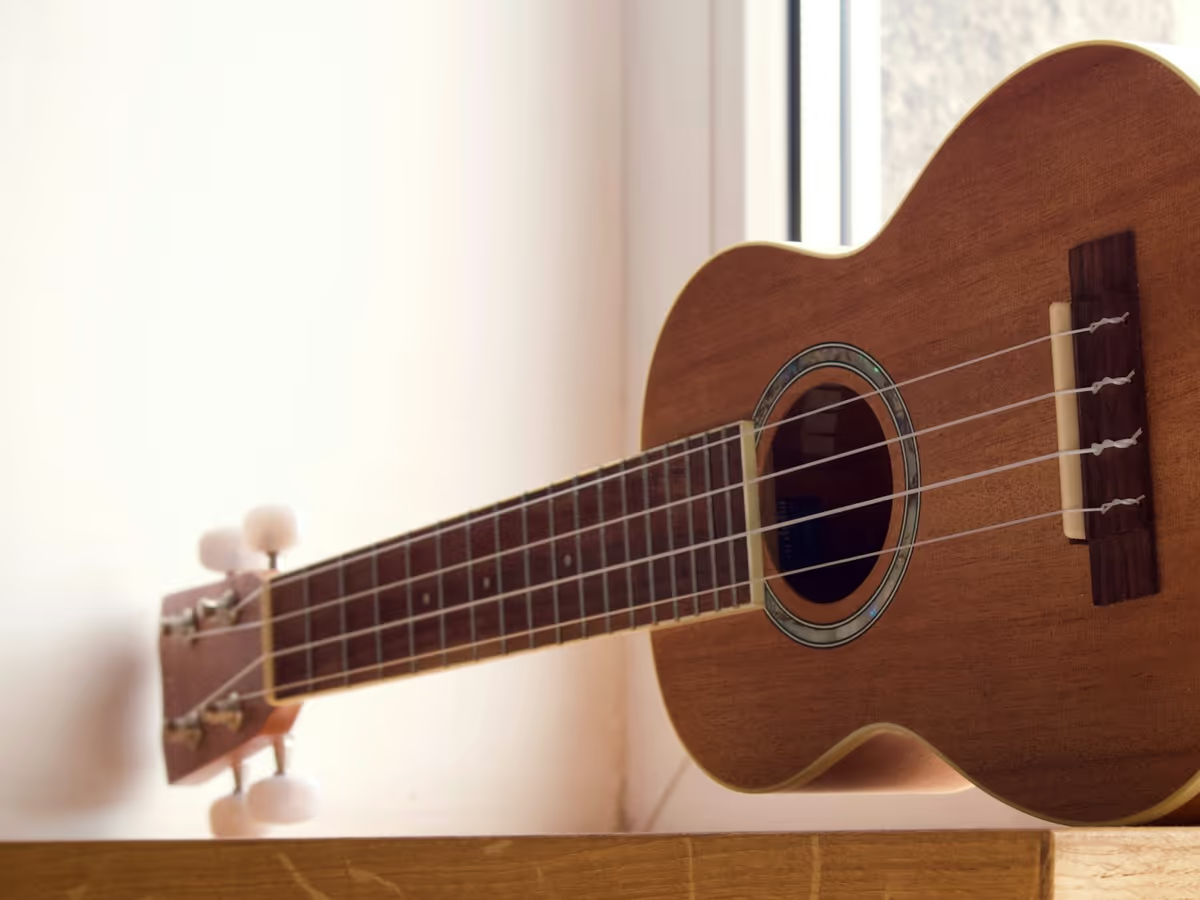
Standard ukulele tuning is G4 C4 E4 A4, or 392.00 Hz, 261.63 Hz, 329.63 Hz and 440.00 Hz. It is a re-entrant tuning: the fourth string, G, is higher than the third, C. That gives the ukulele its bright, close chords. If your ukulele uses a low-G string, switch to Chromatic mode and tune that string to G3 at 196.00 Hz.
The violin is tuned in fifths, G3 D4 A4 E5: 196.00 Hz, 293.66 Hz, 440.00 Hz and 659.26 Hz. Most violinists tune the A first, then the others against it. The cello is also tuned in fifths, an octave and a fifth below the violin, at C2 G2 D3 A3: 65.41 Hz, 98.00 Hz, 146.83 Hz and 220.00 Hz. The viola sits between them at C3 G3 D4 A4; use Chromatic mode for it.
Why tuners read in cents, not hertz
A cent is one hundredth of a semitone, and an octave has 1,200 cents. Cents are useful because pitch is heard as a ratio, not a difference. A string 2 Hz sharp at the low E (82.41 Hz) is about 42 cents out, nearly half a semitone. The same 2 Hz at the high E (329.63 Hz) is only about 10 cents out. A reading in hertz would make those two mistakes look equal; cents show which one matters.
The needle covers ±50 cents, half a semitone either way. Past that point, the tuner considers the next note closer, so in auto mode the note name changes. When you pin a string, the needle stays at the edge and the readout counts semitones instead, so you always know which way to turn.
The in-tune zone lights up when a string reaches 3 cents of the target and stays lit until it drifts past 5 cents. A difference of a few cents is hard to hear on a single note, but it shows up as a slow beating when two strings play together, which is why chords sound clearer after careful tuning.
A4 = 440 Hz vs. 432 Hz and 442 Hz
Every note on the tuner is calculated from one reference: the A above middle C. The international standard sets that A4 at 440 Hz, and nearly all recorded pop, rock and film music uses it. Leave the setting at 440 unless you have a reason to change it.
Many orchestras tune slightly higher, often to 442 Hz, for a brighter sound; 442 is about 8 cents above 440. If you play along with an orchestra or a piano tuned that way, set A4 to match. Baroque ensembles often play at 415 Hz, almost exactly a semitone below 440, so the same fingering sounds lower.
Tuning to 432 Hz has become popular online, and some musicians prefer how it feels. It is about 32 cents below 440, roughly a third of a semitone, so a guitar tuned to 432 will sound out of tune with recordings and other players at 440. Choose it when everyone in the room uses it.
The A4 control accepts any whole number from 415 to 466 Hz. The string targets, the reference tones and the note names all follow it, and the tuner remembers your choice.
Getting a steady reading on a phone
Phones are built to capture speech, and browsers normally add echo cancellation, noise suppression and automatic gain to microphone input. Those features smear pitch, so this tuner switches them off. The trade-off is that the microphone hears the room as it is: fans, traffic and other instruments included.
Distance is the biggest lever. Moving from a metre away to 20 cm makes the string much louder than the room, and the needle steadies at once. Point the bottom edge of the phone toward the sound hole or the f-holes, and keep your hand off the microphone opening.
If the reading still wanders, the note may be too short or too quiet. Pluck a little harder and let it ring. For an electric guitar without an amp, hold the phone right next to the strings near the bridge pickup; the unamplified sound is quiet but usually enough.